Note (10/2/21): This was originally written in 1/21 as an introduction to my thesis, before later being cut. What follows is an adapted version, a sketch of some wonderful moments in Utah this past January.
Senegal never crosses my mind this morning. Nor does the impending semester or job hunt, next steps and looks back, the forward march of time, and utter speed of it all.
No. In the suspended haze of pre-dawn, trusty red headlamp beaming cross-hatches of relief onto unmarked trail, I’m consumed only by my rasping breath, and lulling rhythm of two tattered boots biting through crisp wafers of snowpack. Three friends follow nearby, but for now, this moment is completely and entirely mine.
A hair over 12 hours ago, I discovered a mason jar, and while that might seem wholly unremarkable, the reasoning behind it is anything but. For the past week — accompanied by 10 friends, three cars, 1400 driving miles, and one rustic Airbnb cabin — I’ve been in Utah. We’ve kept busy: sightseeing around the state, exploring the cabin area, and enjoying our *ahem* goodies purchased in Colorado… but yesterday, the penultimate eve of our road trip, was planned around nothing in particular.
Sometime that afternoon, though, feeling premature nostalgia ahead of our departure, I venture out on a solo hike. It’s a lonely tongue of country road I walk, flanked to my right by the steely powder coating Scofield Reservoir, and to my left by one of the sharply graded hillsides that almost perfectly encircle the picturesque lake, as empty bleachers to a football pitch. I head left to the latter, absent-mindedly, feeling the ever-primal urge to climb elevation. The going isn’t easy. It’s sunny but frigid, with no clear path up, and each step compacts snow deeper down the tops of my boots. After near an hour of calf-deep, breathless scrambling, high-stepping around minefields of thorny desert shrubs and mounds of deer droppings, I pause under a gnarled old tree.
A few false summits have come and gone — and I’m ready to call it quits — but I feel the true peak is close. And indeed it is. It takes only another five minutes of trudging before the terrain finally levels. The dry desert wind whips indiscriminate circles as a large pile of stones — a rock cairn, maybe 3x3ft — settles into view. Surrounded only by untouched snow and a silent phalanx of equally gnarled trees, it’s a summit as lonely as the road twisting far beneath it. Still, the view is breath-taking — hills and lake all around, toothy peaks of the Manti-La Sal National Forest a distant mirage — and I can’t help but whoop and holler, a victory celebration for none to hear. I’m elated but shivering, on an adrenaline high but soaked through my socks, and after a few minutes of rest make one last pass around the cairn when I see it, nuzzled deep into an alcove between two rocks.
A mason jar, holding a single folded paper. I extract the jar, and then paper, with chapped fingers. There’s a delicate scrawl on it, so faded as to be mostly unreadable. A few words I do pick out, squinting and holding the note to the sky: peaceful serenity; beauty; mountaintop; lake; love. There’s a name I can’t make out, but a date I can: August 2014.
I lower the paper and lift my gaze to this vista that is indeed that: peaceful, beautiful, serene. I wonder about the origin of the jar: Whose idea was this? Where are they now? Do they remember their offering to the summit?
I was fifteen when this jar was placed, and it’s easily possible none have laid eyes on it since. It feels almost intrusive to come across, this inert bottle cast off in an inert ocean to an unknown end. Carefully, I place paper into jar, and jar into alcove. And as I descend the mountaintop, step suddenly lighter but mind still at the peak, I can’t help but think of my own life, and particularly recently, the passage of time within it.
Almost exactly a year ago (as of this writing, 1/2021), I left for Senegal. For four months I was to be living, learning, studying, interning, and experiencing in a new culture, country, and continent. And I did just that — taking in its squat buildings and burnished colors, vibrant dress and rich food, craggy beaches and controlled cacophony — for two of them. Clichéd though it may sound, those months touched some of the greatest peaks and toughest valleys I’ve known; none harder than my sudden departure due to COVID-19.
But nearing a full year of pandemic-ridden life, Senegal feels like an entirely different life. I’m a senior now — a second-semester one — and the full weight of this has begun to hit. It’s something we’ve discussed over long hikes on the reservoir, and steaming mugs on the back deck: that we feel robbed of this quarantined year, and unprepared for an end looking to lack much closure.
This is hard to vocalize, though; a topic guiltily kept to hushed tones. We all feel for ourselves, and what we’ve lost to the pandemic, but feel equally or more for others less fortunate. It’s a privilege — more than a privilege — to be in this serene place while the world seemingly burns all around. So perhaps grief is just a tricky thing. We each can — must — grieve for ourselves and ours, so long as we contextualize it in regard to others and theirs.
After all, if these four years of undergrad have offered me one overarching thing, it’s a broadening of perspective. Preferring generalization over specialization; thinking in systems rather than parts; searching out diversity over homogeneity; caring for all life beyond human life; considering the global over simply the local.
These are lenses through which I view the world — interchangeable but overlapping. And, both directly and indirectly, they have led me here: to the friends I’ve found, places I yearn to travel, values I maintain, and future I seek.
In other words, they’ve led me to the knotted spine of a Utah mountain this January’s dawn, pushed step-by-step by desires melded and shaped over a chapter of life nearing its conclusion.
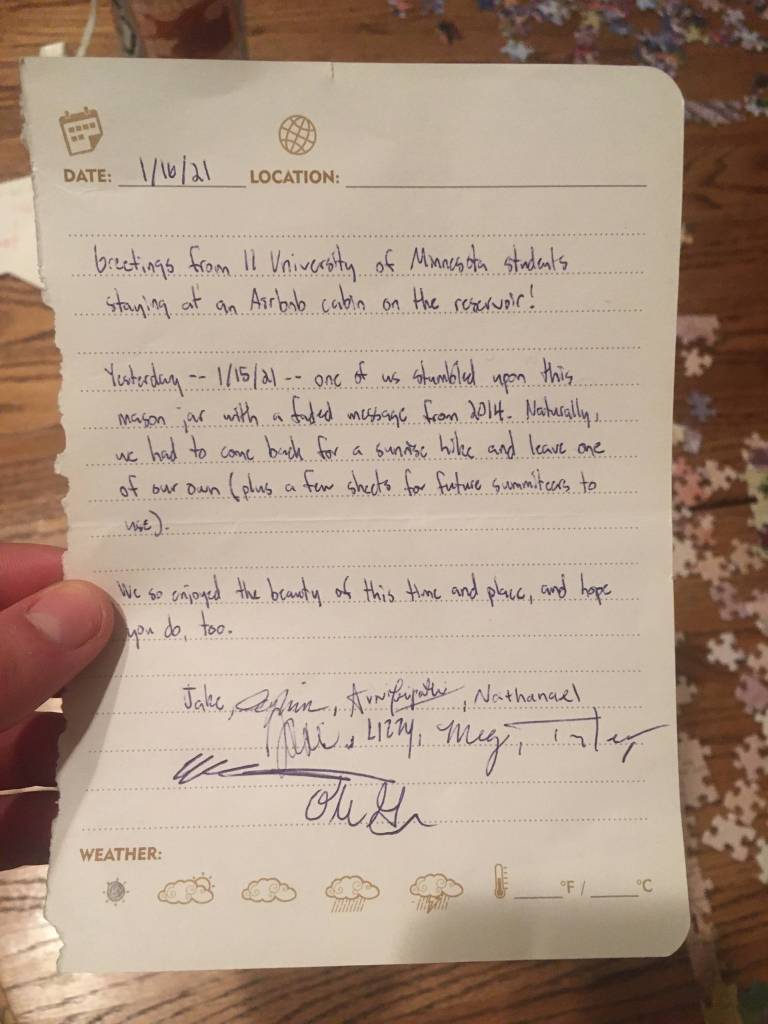
As we climb the haze lifts quietly like fog, dimmer switch to the sky nudging its way up, and soon I flick my headlamp off. I pat around in my jacket, making sure its cargo is secure. No sooner had I wrenched off my snow-compacted boots yesterday than the idea was cemented: a sunrise hike to the summit, leaving our own message in the jar, along with a pencil stub and several blank scraps of paper. Three of my friends are in for the journey; the other seven are not. But we all sign the note I draft up, which is folded carefully in my breast pocket.
In a stroke of wishful thinking (or perhaps naïvety), we’ve all underdressed, and the wind is as biting as ever, so the summit is less ceremonious this time around — just a few pictures, a hasty celebration, pre-occupied by thoughts of breakfast and a crackling fireplace. It’s a bit emotional, though, at least for me. In the moment, I’m not sure why. I just know that someday I’d love to return, and see if the joy I had there was ever shared.
From our offering cast off in hopeful wait, it’s the very last line that sticks with me most: “We so enjoyed the beauty of this time and place, and hope you do, too.”
As the lonesome yet sacred mountaintop aura reminds of, there’s much to be concerned of in this crisis-wrought world, but there’s just as much to protect, to cherish, to love.
 Jake Marble