Note (6/3/22): For about six weeks this spring — from late March to May — I was fortunate to travel and work all over the West Coast for Wilderness Inquiry’s “Canoemobile” program (read all about what the program is below). While out there, I was our “Outreach Lead,” tasked with photography, managing social media, and writing blogs.
So here are the blogs! The first one (written in late March) is pending, and likely to be adapted for a final tour recap post by Wilderness Inquiry, while the second (written in late April) was posted online on June 1st. Hope you enjoy!
Blog #1 – Canoemobile Spring ’22: Paddling Ahead Through Uncertain Waters
Only three weeks into our tour, it’s something we’ve already heard versions of several times: “Wow! What y’all are doing is so cool – it’s not often in your life you get to do something like this, so enjoy and cherish the moment.” This is, of course, in response to folks we’ve met hearing the (somewhat crazy) scope of this Canoemobile: a crew of 7 young people, 3 months, 10+ cities, 1 van-trailer-office-sleeping space, and a more-than cross-country tour spanning some 8000+ miles.
It’s easy to forget – or at least I often do – that what constitutes our day-to-day job falls far outside the norm for the average participant, partner, or curious individual we encounter along the way. Paddling 24-foot-long “north-style” canoes about 5 days / week isn’t in the average job description – without even mentioning everything else that goes into a self-sustaining rig: from paperwork to outreach to gear maintenance to food planning to much-needed self-care. And try as we might to avoid it, it can become a grind. It’s tiring, it’s a heck of a lot of work, and so the truly unique, plain coolness of what we’re bringing to thousands of people across the country… can get lost in the shuffle.
But that’s where those exact people come in. Outdoor education – and really any education – can be a long game. We interact with participants for a short time, pass along as much beneficial knowledge and experience as we can, and are then often left to hoping. Hoping knowledge impacts minds and behaviors. Hoping connections to local environments don’t end when the shared experience does. Hoping to make lasting change in individuals, and thus communities. Canoemobile is no exception. As leaders, it’s easy to get lost in the numbers – first 100 people served, then 250, then suddenly 1500, and on and on – forgetting that while we paddle dozens of times over a tour, most participants get one single shot. And that especially for kids – so affected recently by distance-learning and social isolation – that shot might be particularly meaningful.
This is one kind of important re-contextualizing: Canoemobile through the lense of the participant. Or in other words, context on the micro-scale. Another kind to think about is on the macro-level: Canoemobile in light of global events.
It can almost go unsaid that Russia’s invasion of Ukraine has hung a cloud over the present moment. Compound the various threats it presents with existing conflicts, COVID’s continuation, climate / ecological crises, economic turbulence, other socio-political instabilities – to name only some – and it’s simply a stressful and uneasy time to be alive. I know it’s something I reflected on before our departure: that there’s a kind of innocence, or lightheartedness, lost with our tour when many global issues feel so crushing – and in some ways untouchable. Not that it was ever the goal of Canoemobile to right the world’s ship (no pun intended); just that the waters ahead may appear more uncertain than ever.
But yet, we’re here. Facilitating great programming; connecting folks to their local outdoor spaces; teaching valuable things and making people happy; maybe even giving others (and ourselves) a bit of a reset from the stressors of the world. Which also makes for some valuable context: that sometimes you gotta put that world aside, and positively impacting local communities may be one of the best ways to do it. So we’ll keep paddling ahead – enjoying and cherishing the moment as best we can. What we’re doing is making a difference, both in-the-moment and – even if hidden from view – for the long-term.
That ultimate impact might be summed up best by one moment in Santa Barbara, on our very first day of tour programming. We were getting ready to kick things off with the Alpha Resource Center, a social services organization for adults with developmental and cognitive disabilities. Some of us were chatting with Amy Buesker, Alpha’s staff leader, when she told us about one participant who was thrilled to finally have Canoemobile back in town: “She’s been asking me practically every day for the past two years – ‘When will we get to go canoeing again’?”
Blog #2 – Canoemobile Spring ’22: A Day in the Life
Welcome to Wilderness Inquiry’s Spring 2022 Canoemobile tour! Whether you know a lot or a little about Canoemobile – or have no idea what this incredible program is – we want to provide an overview and dive into what a day in the life on tour looks like.

Canoemobile is often described as a traveling “floating classroom.” The Canoemobile season extends from March to November every year, with national tours each spring and fall, and Minnesota statewide tours and local programming in the Twin Cities throughout the season. On a tour, crews of 7-8 Wilderness Inquiry Outdoor Leaders travel the country quite literally bringing canoeing, outdoor education, and recreation opportunities to youth, families, and communities far and wide. For each journey, our crew packs a van full of equipment, hitches a trailer loaded with gear and six, 24-foot handmade canoes, and caravans from city to city, state to state, all across the country. Once in a community, Canoemobile brings students – and occasionally families and adult groups – out on their local waterways for paddling and learning close to where they live. Participants learn about water safety, science, local history, culture, and career paths in the outdoors from the seat of our 10-person canoes. This program also teams up with local partners who facilitate rotations of land-based activities such as nature hikes, orienteering lessons, macro-invertebrate hunts, and other relevant experiences that complement and enrich the experience.
At the time of this writing, the Canoemobile 2022 spring tour is on the final leg of our West Coast portion – which started in Santa Barbara, CA, and continued in Galt, CA (south of Sacramento), Orland, CA (north of Sacramento), San Francisco, and Salt Lake City, UT. The rig then heads back to Minnesota for a “refresh” before heading out on the East Coast leg, which includes stops in Austin (MN), Michigan, New Jersey, New York, and Illinois.
To give you a better idea of what the day-to-day looks like while on tour, Wilderness Inquiry staff member Jake Marble put together a run-down of what it’s like to live and work on a traveling rig of 10-person canoes.
4/19/22 – Lake Merced, San Francisco, CA
6:00-6:55 am: Wake up call! On Canoemobile, departure times vary based on daily program times – and get-out-of-bed times also vary based on the individual. Some like to get up early and have a slower start, while others (lovingly teased about this) prefer to squeeze out every last ounce of sleep. Group tasks in the morning include packing a lunch cooler, ensuring walkie-talkies and other gear are moved to the van, and hitching up the canoe trailer (if not already done.)

7:00 am: This was our trademark “Butts in Van” time du jour – a somewhat tongue-in-cheek way of making sure we actually leave at the set time. Pretty much, if you aren’t sitting in the van ready to go, you’re late!
7:30-7:45 am: This particular day we arrived at Lake Merced Park after a 30-45 minute commute that took us from YMCA Camp Point Bonita, over the Golden Gate Bridge, and through the heart of San Francisco. Early morning commutes offer a bit of needed peace and quiet for us before the frenzy of whatever the day has in store – reading, listening to music, or even catching a few extra ZZZ’s are all common.
7:45-8:30 am: Prep, prep, prep! We get all of our pre-program work done before our first group of the day arrives. This includes unloading, carrying, and docking however many canoes we need that day, neatly laying out different sizes of PFDs and paddles on tarps, putting our extra-long stern paddles and safety gear (throw rings, bailer buckets, throw ropes) in the canoes, gearing ourselves up with PFDs, walkie-talkies, sunscreen, face masks, etc., and any last odds and ends that come up. This process gets pretty dialed in over the course of a Canoemobile tour – our record is under 15 minutes!
9:00-10:30 am: Program days vary by how many sessions there are – today we have three! The first session is with 30, second-grade students and a few teachers/chaperones from Alamo Elementary. Second grade is at the younger end of students we take canoeing – too much younger and paddling (especially on larger, windier bodies of water like Lake Merced) can become difficult without adult or parental assistance. On our tour, we like to tell people we work with people from ages 8 to 88 – which is fairly accurate! When it comes to programming, pretty much every Canoemobile session – today’s included – follows this general order:
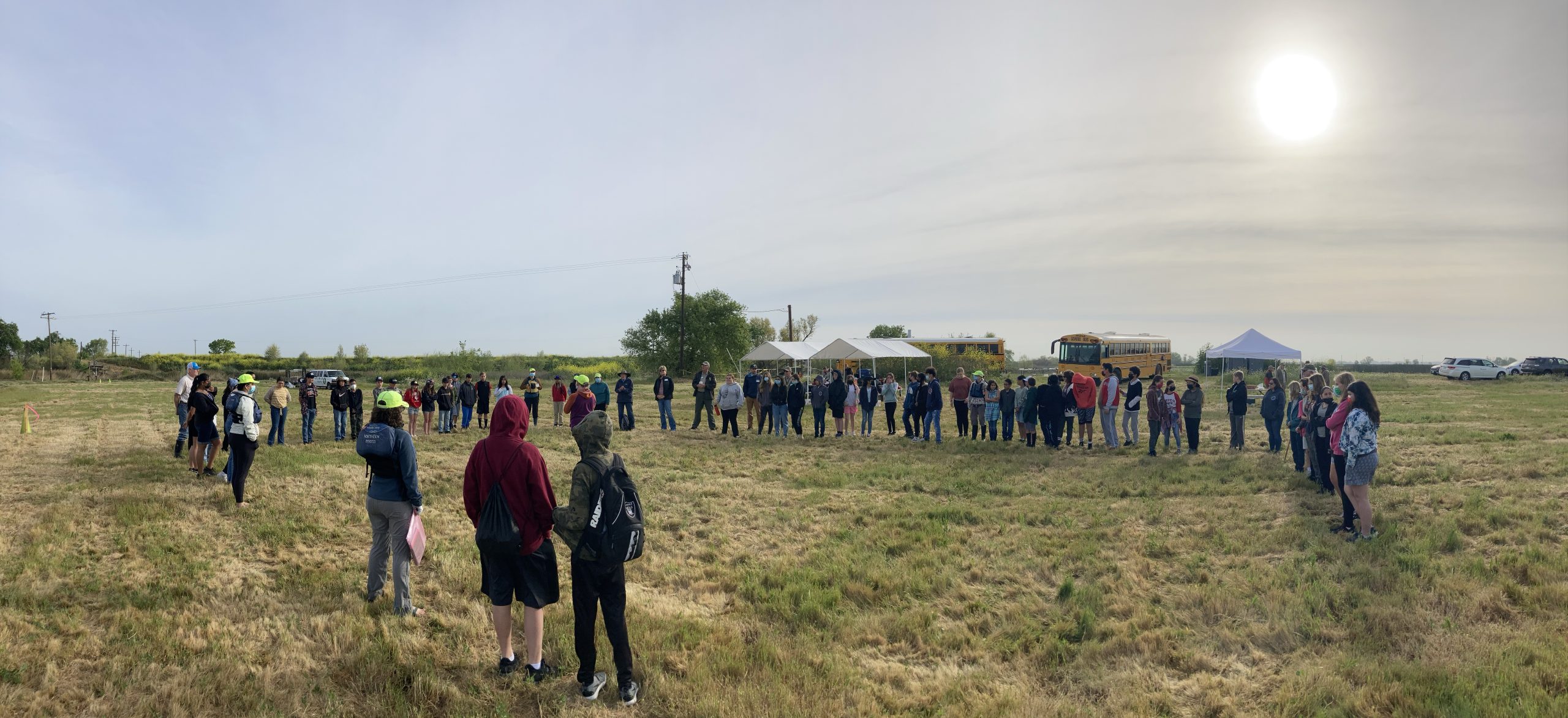
- Large welcome circle where we introduce ourselves, Wilderness Inquiry, any partners facilitating land-based activities, and do a land acknowledgement. Then we play a group game while 1-2 of our staff do a “Teacher Talk” with teachers/chaperones that includes final logistics to ensure the day runs smoothly.
- After this, students are split up into groups – this was a canoeing-only day but when we have land-based programs as well, that time is also factored in.
- Program time! For canoeing, first up are “paddle safety talks” – when we teach safety rules, paddle techniques, gear everyone up with PFDs and paddles, and most importantly, have students choose a cool boat name (example: “The Spicy McNuggets!”). Then we get out on the water for the remaining time – looking for wildlife, enjoying the water, and sometimes racing each other.
- Closing circle: after all the activities wrap up, everyone gathers one last time. We ask students to reflect and share about the day, and do group thank yous to all the people making it happen: teachers/chaperones, our staff, land partners, bus drivers, and finally, the students themselves for participating.
10:45 am-12:15 pm: Session #2 kicks off soon after the first group departs. For this group, we have two more classes from Alamo Elementary (fourth and fifth grade students) as well as a small group from Lowell High School. This was structured the same as Session #1, but one notable moment offered a good reminder of the varying levels of experience / comfort with canoeing (and water in general) our participants may have. It can be easy to forget how nerve-wracking canoeing can be if you’re new to it, but very valuable to keep in mind:

Meet Jordan! He’s a 9-year-old from Alamo – when his canoe group began loading, he expressed a lifelong phobia of water, and was feeling very unsure about going. Though his classmates, teacher, and boat captain all cheered him on, he eventually decided to stay on land. But that’s where the progress began! With the patient help of Wilderness Inquiry staff Hannah, one of the tour’s Co-Primary leaders, the two of them sat on the dock, working on making Jordan feel more comfortable. He got to practice handling both a regular paddle and stern paddle (as pictured – it’s taller than him!), and got the run-down on all the safety features of our canoes. Within minutes he worked up to sitting in – and paddling off the side of – a docked 10-person canoe. By the time this photo was taken, he was visibly in much better spirits. And when I asked if he’s thinking of going out in a canoe sometime? His answer: “I definitely want to try.”
12:15-12:45 pm: Staff lunch! Enough said, really. We’ve usually worked up a big appetite, so we wolf down food and relax for a few minutes here between sessions.
12:45-2:15 pm: For our final session of the day we had about 20 staff members from San Francisco Recreation & Parks Department come for a staff-bonding experience. It’s always cool for us as Canoemobile staff to work with a diverse range of ages in a single day. It also offers a nice challenge when it comes to how we tailor our teaching and program facilitating, since it’s usually structured around youth. This wound up being a really fun paddle with some friendly coworker competition and banter between the canoes.
2:15-3:15 pm: Clean up everything! Sponge-wash the canoes! Repack the trailer! Lift and strap all boats! Basically, not the most fun part of a busy Canoemobile day, but we try to liven it up and work efficiently.
3:15-4:30 pm: The commute back to our current lodging at the YMCA, and from there we take care of daily post-program responsibilities: this usually involves tallying waivers, completing paperwork, emptying lunch coolers, and doing outreach and social media tasks.
4:30-11:00 pm: Time off – woo hoo! Everyone has their own ways to decompress and practice self-care while on tour – some favorites include napping, hiking, running, shopping, or calling friends and family – though some options are dependent on where we’re staying and what the group is up to. We manage our own food budget on tour, so most weeks are a mix of cooking at home or in camp and eating out at local restaurants. Most staff probably agree that one of the best perks of the job is the paid travel – seeing new places, trying new things – so we typically pack in a lot of sightseeing at each location which is always a highlight for everyone.
That’s a day in the life on a Canoemobile tour and a good sense of what this incredible program is all about. It’s a unique, crazy, awesome experience bringing positive opportunities to thousands of people. And as for us, once each whirlwind day is over, it’s time to do it all again!
 Jake Marble